Thursday, May 31, 2012

GLOBAL MARKETS-Stocks weakest in 8 mos; US bond yields hit lows


 S&P 500 and euro post sharpest monthly loss since Sept
* Oil prices down 16 pct for May, worst since Dec 2008
* U.S. Treasury yields hit fresh 60-year lows
Stocks ended May with their largest loss in eight months and commodities also took a battering after a spate of worrying U.S. economic data on Thu rsday hit markets already reeling from Europe's debt troubles.
The euro had its worst performance since September too, repeatedly hitting a near two-year bottom.

391663_120x90 logo

U.S. bond yields fell to record lows as fears about Spain's troubled banks and Greece's possible exit from theeuro zone spurred a global race for safe assets.
Many investors braced for another round of risk aversion on Friday should the monthly jobs report from the U.S. government contain weaker numbers than preliminary data issued by a payrolls processor on Thursday.
"Europe is the main issue, no question about it, but you have a supporting cast from the U.S. data," said Paul Zemsky, head of asset allocation at ING Investment Management in New York.
Spain remained the focal point of traders on growing speculation that Madrid would sooner or later ask for outside help to bail out its banks. Wall Street pared some of the day's losses on a report -- later denied -- of possible International Monetary Fund aid. But the European Commission has offered direct aid for a euro zone rescue fund to recapitalize distressed Spanish banks and more time for Spain to reduce its budget deficit.
Markets got an inkling of what was to come in Friday's U.S. jobs report after payrolls processor ADP said private employers created 133,000 jobs in May, fewer than the expected 148,000. New claims for unemployment benefits rose by 10,000 for the fourth straight weekly increase, the Labor Department reported.
Investors were dismayed by another report on economic growth and manufacturing in the U.S. Midwest that pointed to a slowdown.
At the close, the Dow Jones industrial average was down 26.41 points, or 0.21 percent, at 12,393.45. The Standard & Poor's 500 Index lost 2.99 points, or 0.23 percent, at 1,310.33. The Nasdaq Composite Index fell 10.02 points, or 0.35 percent, to 2,827.34.
For the month, the S&P 500 was down 6 percent -- its sharpest loss since September.
European stocks closed down 7 percent for May and global equities tumbled 10 percent -- also marking their worst showing since September.
Commodities fell even more, with crude oil futures plunging 15 percent for the month both in London and New York for their biggest loss since December 2008. Copper lost 11 percent for the month.

525035_125 x 125 10% Off Banner

"There's a lot of instability in the world, and along with the weak economic signals there's going to be significant volatility that I don't expect to end anytime soon," said Don Steinbrugge, managing partner of Agecroft Partners in Richmond, Virginia.

The benchmark 10-year U.S. Treasury note rose 12/32 in price, its yield at 1.578 percent -- down from Wednesday's 1.6 percent levels, which already marked a 60-year bottom.

Wednesday, May 30, 2012

Stocks Retreat in Broad, Euro-Fueled Selloff


Wall Street pulled back sharply on Wednesday in stark contrast to the big gains seen in the prior session as traders were once again forced to grapple with the specter of the eurozone's debt debacle bleeding into core nations.

Today's Markets 


NYSE Trader Looking at Monitors
A NYSE Trader
The Dow Jones Industrial Average fell 161 points, or 1.3%, to 12420, the S&P 500 dipped 19.1 points, or 1.4%, to 1313 and the Nasdaq Composite slid 33.6 points, or 1.2%, to 2837. The selling was fierce on the day, with trades in advancing shares outpacing those in declining shares by more than 11-to-one. As a result, traders fled to the protection of safe-havens, such as U.S. Treasury bonds. Indeed, the yield on the benchmark 10-year note tumbled 0.104-percentage point to 1.627% -- the lowest since at least 1977.  Volatility, meanwhile, lurched higher by more than 11% as tracked by the CBOE's VIX. Energy shares struggled the most on the day by far on the back of a rout in oil markets that knocked crude to its lowest level since October 2011. Other economically-sensitive sectors, such as financials, industrials, basic materials and consumer discretionary shares, all took a thrashing as well. Traditional defensive plays like health-care and utility stocks held up the best, but still fell. 


Spain Takes Center-Stage as Europe's Debt Crisis Heats Up
In yet another sign that the eurozone's debt crisis is spreading from periphery nations straight into the currency bloc's core, market participants were focused squarely on Spain. The Financial Times reported late Tuesday that the European Central Bank was considering a move to block Spain from recapitalizing ailing lender Bankia on legal grounds. 


Tuesday, May 29, 2012

RIM warns of operating loss, layoffs to come


Struggling BlackBerry-maker Research in Motion warned Tuesday that it will have an operating loss in its current March-June quarter and said there will be significant layoffs this year.
RIM also said in a release that it has hired J.P. Morgan and RBC Capital Markets to help the company evaluate various strategies, including opportunities to partner with other companies and license software as well as other alternatives.
Waterloo, Ontario-based RIM made no mention of a sale of the company but new chief executive Thorsten Heins did not rule it out after RIM's last earnings were released in late March.
"It's a disaster, it's bad," Jefferies analyst Peter Misek said. "The problem is you can't see a path to a sale until you stabilize the business."
Misek said if the advisers weren't brought in to consider a sale originally they are likely considering it now. Misek expects RIM to announce as many as 5,000 layoffs soon.
RIM's stock was halted in after-hours trading Tuesday. When trading resumed shares fell more than 10 percent, or $1.20, to $10.03.
The once-iconic RIM, the company that pioneered the smartphone market with its Blackberry phones, is facing the most difficult period in its history. RIM's U.S. share of smartphones dropped from 44 percent in 2009 to 10 percent in 2011, according to market researcher NPD Group. The company still has 78 million active subscribers across the globe, but Apple and Android phone makers such as Samsung and HTC are taking market share.
The company is working on the launch of a new software operating system, but that's happening just as North Americans are abandoning their BlackBerry's for flashier and more versatile smartphones like Apple's iPhone and phones that run Google's Android software.


Monday, May 28, 2012

Euro slide silver lining for exporters


Steep declines in the euro symbolise the woes of Europe's monetary union but could have a silver lining: the boost to exporters may offer some much-needed support to economic growth across the 17-country region.

The fall of the euro could help eurozone exporters.Last year, even as the euro crisis escalated, the currency's value remained remarkably steady. In recent weeks, however, financial market sentiment towards the euro has turned decisively for the worse.


Memorial Day Free Ground Shipping


On a trade-weighted basis, the euro has fallen by more than 6 per cent over the past year to the lowest since 2003. Against the dollar, the euro has dropped to a near two-year low of about $1.25.


On a rough rule-of-thumb used by economists, a 10 per cent fall in the euro's trade-weighted value should boost economic growth by about 0.5 percentage points or more.


A fillip would be timely. Eurozone purchasing managers' indices last week showed private sector activity contracting this month at the fastest rate for almost three years, as worries about the eurozone's stability compounded the impact of fiscal austerity across much of the continent.


Friday, May 25, 2012

Typical CEO made $9.6M last year, AP study finds


Profits at big U.S. companies broke records last year, and so did pay for CEOs.

The head of a typical public company made $9.6 million in 2011, according to an analysis by The Associated Press using data from Equilar, an executive pay research firm. That was up more than 6 percent from the previous year, and is the second year in a row of increases.
The figure is also the highest since the AP began tracking executive compensation in 2006.


Companies trimmed cash bonuses but handed out more in stock awards. For shareholder activists who have long decried CEO pay as exorbitant, that was a victory of sorts.

That’s because the stock awards are being tied more often to company performance. In those instances, CEOs can’t cash in the shares right away: They have to meet goals first, like boosting profit to a certain level.

The idea is to motivate CEOs to make sure a company does well and to tie their fortunes to the company’s for the long term. For too long, activists say, CEOs have been richly rewarded no matter how a company has fared — “pay for pulse,” as some critics call it.

To be sure, the companies’ motives are pragmatic. The corporate world is under a brighter, more uncomfortable spotlight than it was a few years ago, before the financial crisis struck in the fall of 2008.


Last year, a law gave shareholders the right to vote on whether they approve of the CEO’s pay. The vote is nonbinding, but companies are keen to avoid an embarrassing “no.”

“I think the boards were more easily shamed than we thought they were,” says Stephen Davis, a shareholder expert at Yale University, referring to boards of directors, which set executive pay.

In the past year, he says, “Shareholders found their voice.”

The typical CEO got stock awards worth $3.6 million in 2011, up 11 percent from the year before. Cash bonuses fell about 7 percent, to $2 million.


Wednesday, May 23, 2012

Facebook's IPO: Sorting through the legal mess


At this point, there's little question that Facebook's IPO was a disaster. But was it illegal?
That's the question lawyers, regulators, and other observers are asking as allegations swirl that major clients of Morgan Stanley (MS, Fortune 500) and other banks involved in the offering may have had access to privileged information ahead of the stock's debut.
"We need to be assured that everyone, every investor, gets treated the same," William Galvin, the secretary of the commonwealth in Massachusetts, told CNN Wednesday. Galvin has issued a subpoena to Morgan Stanley seeking information about the bank's contacts with clients ahead of Facebook's IPO last week.
Law enforcement officials have not formally accused either Facebook (FB) or the banks that underwrote itsIPO of wrongdoing. On Wednesday, however, lawyers representing investors who purchased Facebook stock filed suit against the tech giant and the banks involved alleging that they withheld information that should have been disclosed in public documents.


Hewlett-Packard And Google Look Much Better Than Facebook

Facebooh Sares had their best day since the company went public last Friday, gaining 3.23% to close at $32 on Wednesday.   At its nadir on Tuesday, Facebook was down 18% from its $38 offering price.

With the haircut that Facebook has taken since its debut at a market capitalization of $104 billion, valuations have come down considerably, but hardly to the point where many investors would consider the stock to be a bargain.  Facebook still trades at 74 times its trailing 12 months of earnings with its sales growing by 45% in the January-March quarter and profit down 12%.  Compare that to Google with a trailing P/E of 18.5 with sales higher by 24% and net income up by 61%.  If you believe that the company growing sales and profits by a higher rates deserves a higher earnings multiple, you still have to favor Google over Facebook.
Several technology stocks trade far more cheaply than even Google.   In fact, names like Intel and Microsoft both trade for 10.7 times trailing earnings and offer chunky dividend yields of 3.2% and 2.7% respectively.  The problem is that both of these companies have franchises that are closely tied to personal computers.  By the looks of Dell’s disappointing earnings report on Wednesday, along with the rise of tablets and smartphones as PC substitutes, that isn’t such a great place to be.

Tuesday, May 22, 2012

Dell Profit Falls By A Third, Sending Shares Lower


Dell Inc.'s (DELL) fiscal first-quarter earnings slipped 33% as the computer maker reported lower revenue in its consumer, public and large enterprise customer segments because of increased competition and poor execution.


Shares slid 11% to $13.35 in recent after-hours trading as earnings missed analyst expectations and the company issued downbeat revenue guidance for the current quarter. Shares of rival Hewlett-Packard Co. (HPQ), which reports Wednesday, fell 2.5% to $21.24.
"There's also a challenging competitive environment we're seeing," Brian Gladden, the company's chief financial officer, said in an interview. He added that the company is making investments in sales capabilities.
"We have to execute better," he said.
Faced with soft PC sales, Dell has been attempting to boost both its revenue and profits by acquiring higher-margin businesses, including data-storage, security and networking technologies. Since 2009, the company has acquired about a dozen companies, including a number in recent months.
Gladden said Dell is continuing to focus on key parts of the business, such as servers, storage and networking. "The strategy we have makes sense, and we're seeing good progress," he said.
In the quarter, though, Dell executives said the company was hurt by poor demand in Europe, Asia and the public sector. The company also said it was seeing more spending diverted to alternative mobile computing devices, such as those made by Apple Inc. (AAPL) or those made using Google Inc.'s (GOOG) Android operating system.

Thursday, May 17, 2012

Facebook prices its IPO at $38 ahead of Friday's trading

Facebook is about to burst out of the IPO gate Friday, with a blistering initial public offering that is expected to raise billions — not to mention the eyebrows of some investors on Wall Street.


FB Going Public

The mega-offering signals a seminal event in the Internet's maturation as a fundamental cog in the world economy, says Dave Morin, CEO of Path, a social network of 3 million and a former Facebook executive. "It sets the tone for long-term, product-driven Internet companies," he says.Priced at $38 a share on Thursday, the 8-year-old social-networking company, fronted by hoodie-wearing CEO Mark Zuckerberg, could raise $16 billion in funding, not including an overallotment option. It could end its first day of trading worth up to $104 billion. That would make it worth more than Disney, Ford and Kraft Foods. It would be the second-largest U.S.-listed IPO behind only Visa. Facebook's market debut, the biggest tech company IPO ever, should create 1,000 millionaires overnight.


Monday, May 14, 2012

Groupon makes first profit, shares surge


Groupon Inc posted its first quarterly profit by reining in marketing spending and signing up more customers and merchants, sending its stock about 18 percent higher.


The fledgling company started by music graduate Andrew Mason, which had lost half its value this year on concern about waning demand for its daily deals and persistent accounting problems, on Monday surpassed Wall Street's expectations for earnings and revenue growth.

The Chicago-based company revised fourth-quarter results at the end of March, admitting to "material weakness" in its financial statements and triggering a stock price slide. Even taking into account Monday's surge, the shares remain well below $20 initial public offering level in November.

Mason, who was criticized last year for heavy spending, told analysts on a conference call he wanted to expand Groupon's mobile business, while using rewards programs and other technology to attract and retain merchants and customers overseas.

He said the company will release new mobile application software in coming months, now that about a third of North American transactions happen on smartphones and other mobile devices.

"Revenue growth was impressive and they also had material margin expansion," said The Benchmark Company analyst Clayton Moran. "There are no signs of competitive pressure in this report. The take rate of 41 percent is very encouraging. Investor fears around competition and sustainability have been overdone."

The after-hours rally to about $13.83 followed a gain of more than 18 percent in regular trading on Nasdaq, its largest single-day gain since it went public in November. Analysts said short sellers scrambled to cover their positions, anticipating better-than-expected results after the bell.

If both gains were combined, they would equate to a 36 percent gain from last week's close of $9.90.

Monday, May 7, 2012

Europe: Now comes the hard part

European Union officials are expected to begin debating ways to boost economic growth, after voters in France and Greece rejected austerity.
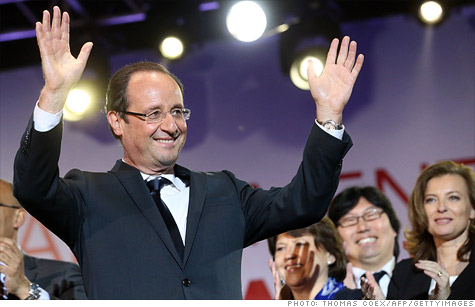
The focus on growth comes after Socialist party leader Francois Hollande defeated incumbent Nicolas Sarkozy in France's presidential election Sunday. In Greece, voters punished the two main political parties, raising concerns that a weak coalition government will backtrack on the nation's bailout program.
hollande
The New French President

At the same time, many European economies have tumbled into recession as austerity measures -- budget cuts and tax hikes -- take a toll on growth.
Hollande has said he would renegotiate the "fiscal compact"that most EU leaders signed late last year to incorporate a "growth dimension." The pact is designed to increase fiscal discipline and prevent a future crisis by ensuring that governments respect deficit rules and do not overspend.
But analysts say Hollande will probably back down on this issue to avoid a conflict with German Chancellor Angela Merkel, who has been the most vocal supporter of austerity.
Given the shifting political winds, the most likely outcome will be a new "growth compact" to complement the fiscal treaty, according to James Goundry, an analyst at IHS Global Insight.
"This should be viewed as the opening salvo in negotiations over additional growth measures to be held with European leaders -- most notably German chancellor Angela Merkel -- over the coming weeks and months," he said.
Many EU officials have already called for measures to boost growth and create jobs.
Over the weekend, Olli Rhen, vice president of the European Commission, outlined his strategy for restoring economic growth in the eurozone.